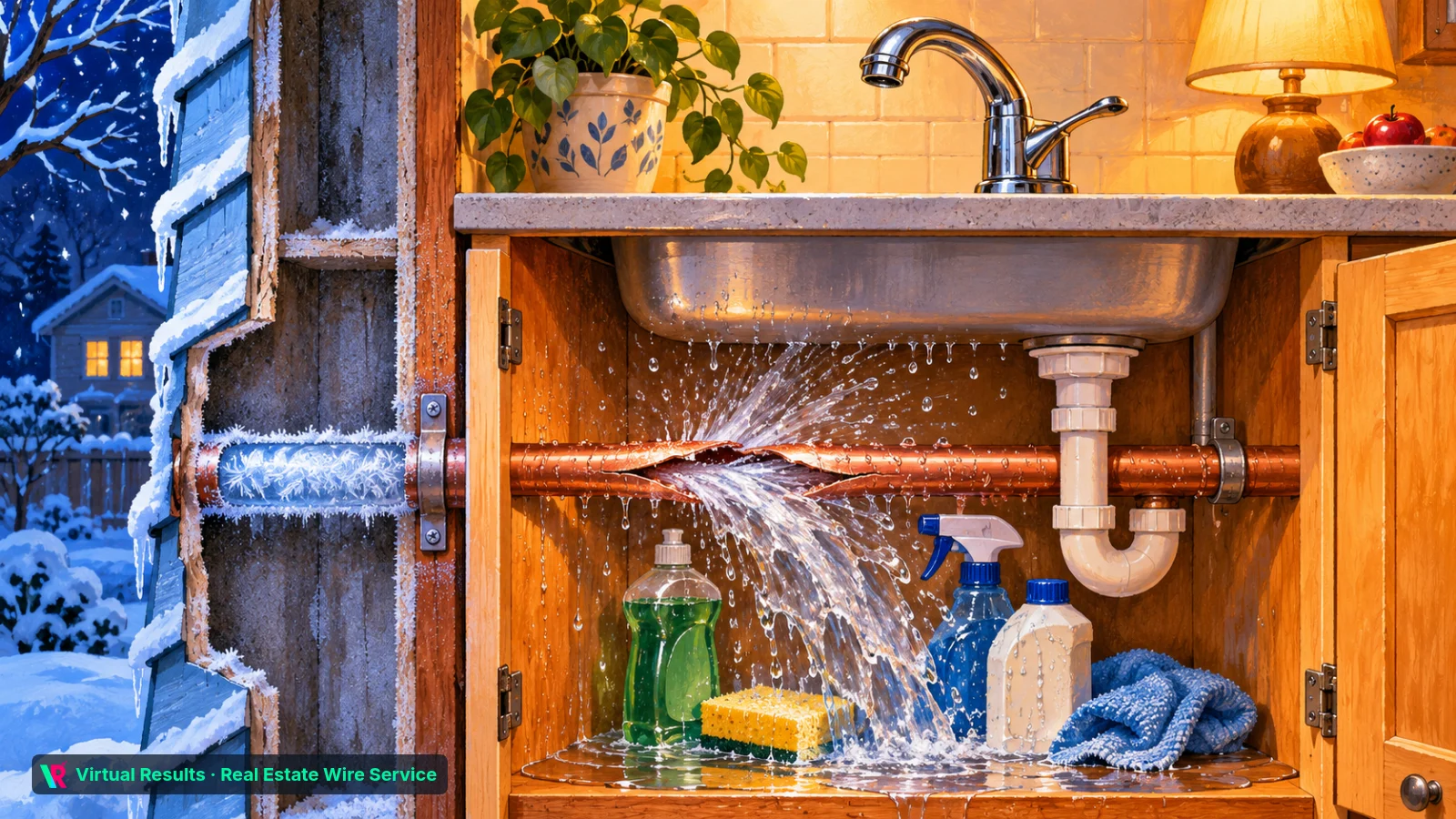
The ice isn't the crowbar. It's the cork. The pipe usually gives way somewhere else: down the line, where the water is trapped.
Based on University of Illinois freeze research, Triple-I and State Farm claim data · About 5 minutes
Picture the usual winter disaster: water freezes, ice expands, the pipe bulges like a soda can left in the freezer, and pop.
That's the version most of us carry around. It's tidy. And it's mostly wrong.
In the mid-1990s, Jeffrey Gordon of the University of Illinois Building Research Council spent two years freezing water pipes on purpose, in research sponsored by State Farm for the insurance-industry group that became today's IBHS. His conclusion, from the 1996 report: freezing pipes "do not burst directly from physical pressure applied by growing ice, but from excessive water pressure."
That may sound like a technical distinction. It isn't. It changes where you should worry, and why a dripping faucet works.
The Ice Isn't the Problem. The Trap Is.
Ice forms first wherever a pipe is coldest: an exterior wall, an attic, a crawl space. As it thickens, it eventually closes the pipe off completely. Now you have an ice plug.
On one side of the plug, water can still retreat toward the street. On the other side, between the plug and a closed faucet, the water has nowhere to go. Water expands as it freezes, so every bit of new ice pushes into that sealed pocket and squeezes it harder.
Normal household water pressure is about 40 to 50 pounds per square inch. In Gordon's test of a three-quarter-inch copper pipe in an unheated attic, the trapped water climbed to about 4,000 psi before the pipe bulged and split. As Gordon put it in the university's 1996 announcement, "a pipe usually will burst in a place that has almost no ice in it."
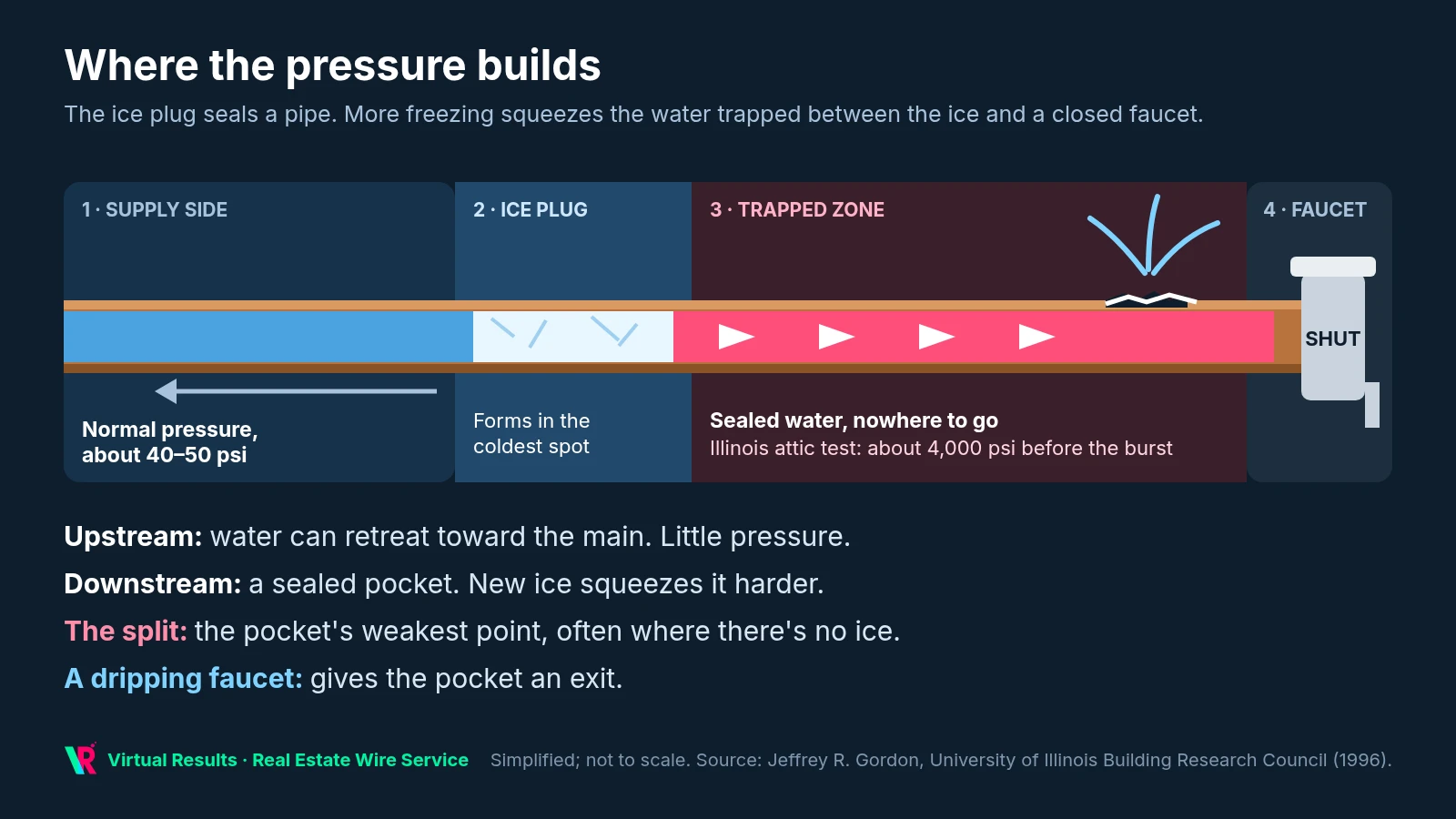
So the split often appears somewhere surprising: a soldered joint under a bathroom sink, a fitting inside a warm wall, a spot several feet from the cold that started it all. Often nobody notices until the ice thaws and the water finally has a way out.
Guess first: which pipes freeze most often?
According to the American Red Cross, three groups: pipes exposed to severe cold (outdoor hose bibs, swimming pool supply lines, sprinkler lines); supply pipes in unheated spaces such as basements, crawl spaces, attics, garages and kitchen cabinets; and pipes running along exterior walls with little or no insulation. Note what's not on the list: anything to do with how far north you live.
The Worst Frozen-Pipe Bills Aren't in the Coldest States
That last point shows up in the money. From August 2022 to August 2023, State Farm paid more than $806 million on frozen-pipe and water claims nationwide. The state at the top wasn't Minnesota or Alaska. It was Georgia, at about $100 million, followed by Illinois, Tennessee, Texas and New York.
Gordon's team saw the same pattern in 1996: the university said the problem was "centered in southern states, particularly along the Gulf Coast," where homes are often built without protecting pipes from outdoor temperatures. A house in Minnesota is designed for January. A house in Georgia is designed for August, and then a cold snap arrives.
One caution: those are one insurer's totals, not a rate per home, so they partly reflect where State Farm writes the most policies. The pattern still fits the physics. Pipes freeze where they're unprotected, not where it's famously cold.
What a Burst Costs Now
Average claim payments for freeze and water damage, from two different datasets. They measure different things, so compare each with its own label.
Sources: State Farm, January 20, 2026 (more than 20,000 claims, over $628 million paid; includes slab and foundation damage); State Farm, December 20, 2024 (2023 data: more than 17,200 claims, more than $432.5 million paid); Insurance Information Institute (includes non-freeze water damage and covered mold).
The Insurance Information Institute adds the frequency: about one in 70 insured homes has a water damage or freezing claim each year. Not every one of those is a frozen pipe, but freezing is the part you can see coming on a weather forecast.
The Cheapest Insurance in the House Is a Drip
Here's where the physics pays off. If the trapped pocket is the problem, give it an exit. A faucet left open, even barely, means the water between the ice and the tap can't be squeezed. As Gordon's report puts it, "a pipe that is open on one end cannot be pressurized, and thus will not burst." The pipe might still freeze. You might wake up to no water. But a frozen pipe with an exit is an inconvenience. A frozen pipe without one is a claim.
So what does the drip cost? Less than you'd think, and you can check it yourself.
To measure your own drip, hold a measuring cup under it. A cup roughly every four minutes is about a gallon an hour. A cup every 15 minutes is a quarter gallon.
When Dripping Helps, and When It Doesn't
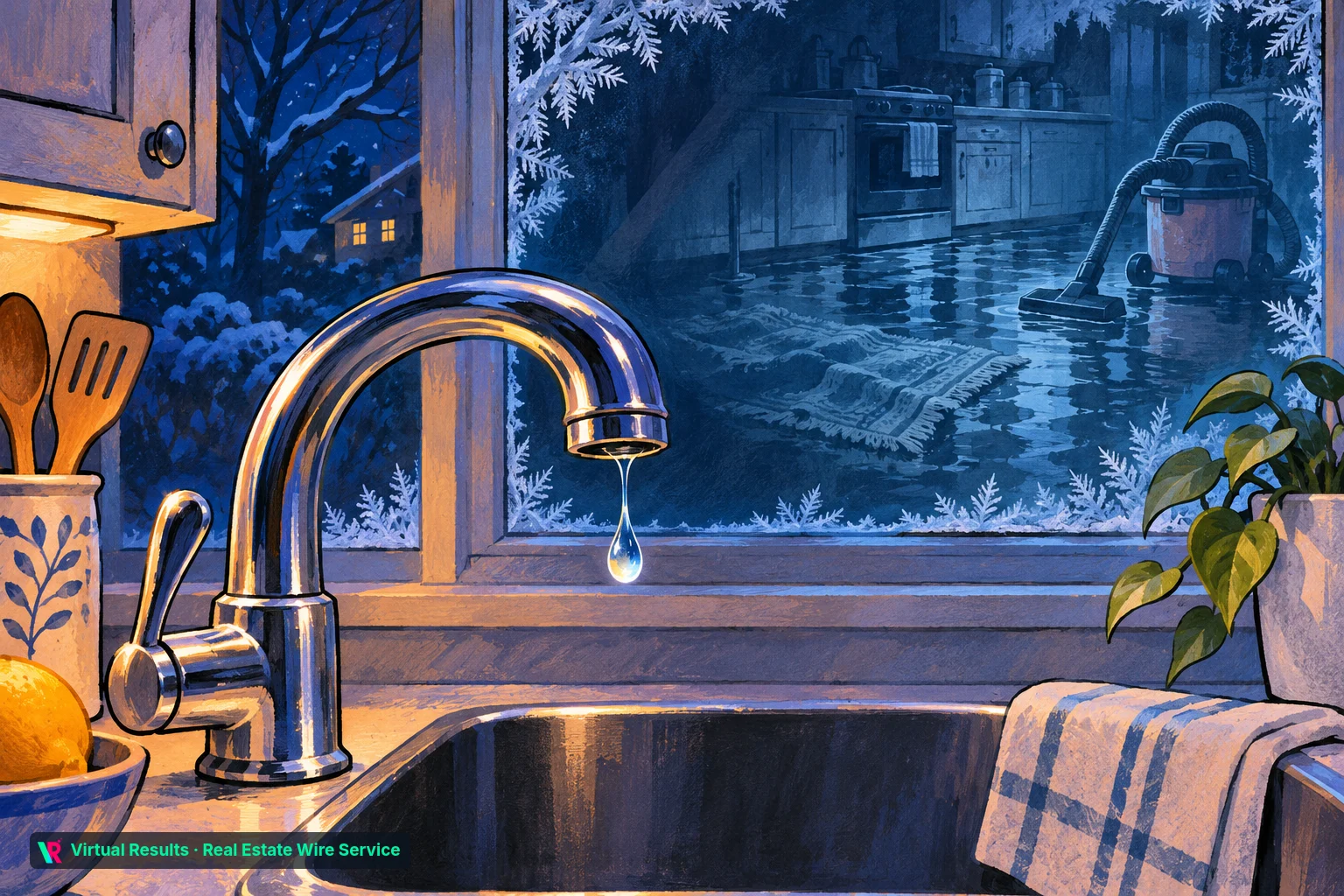
Dripping has real limits, and one of them showed up at city scale.
During the February 2021 Texas freeze, Austin Water's largest treatment plant lost power while broken mains, burst pipes and dripping faucets drove demand far past what the city could produce. Director Greg Meszaros said a home dripping three or four faucets could add up to about a gallon a minute, more than 1,400 gallons a day. "That's 140 million gallons of water a day to just faucet dripping," he told KUT. The city issued a boil-water notice and asked residents to turn the drips off.
A gallon a minute is 60 gallons an hour, far more than the drip in the calculator above. That's the first lesson: a drip means a drip, not a stream, and when your utility asks you to stop, stop. Its water system is protecting your pipes too.
The second: a drip only protects the pipe that feeds that faucet. Drip the kitchen tap and the bathroom line in the exterior wall is still sealed. Lines with no faucet at the end, like sprinkler supplies, get no help at all; those need draining.
And the third: if the heat goes out for days, a drip buys time, not immunity. What survives all three objections is the core idea. Pressure, not ice, does the damage, so anything that gives trapped water an exit or keeps the pipe from sealing helps.
Before the Next Cold Snap
Most of this checklist comes from the Red Cross and State Farm guidance, sorted by the physics above.
- Find your main shutoff now, while it's dry. Make sure everyone in the house can turn it.
- Disconnect hoses and drain outdoor spigots. Close the inside valve for each hose bib, then open the outside spigot so leftover water has room to expand.
- Drain sprinkler and pool supply lines following the installer's directions.
- Insulate pipes in attics, crawl spaces, garages and exterior walls. Foam pipe sleeves are cheap; UL-listed heat cable is an option for the worst spots.
- On very cold nights, let cold water drip from the faucets served by exposed pipes. A drip, not a stream.
- Open sink cabinets on exterior walls so room heat reaches the pipes. Move cleaners out of children's reach.
- Keep the thermostat steady day and night, and if you travel, leave the heat at 55°F or higher.
If a Pipe Freezes Anyway
- Suspect a freeze when a faucet gives only a trickle. Likely spots are exterior walls and where the water line enters through the foundation.
- Leave that faucet open. That's the exit the trapped water needs, and flowing water helps melt the ice.
- Warm the pipe gently with a hair dryer, an electric heating pad or hot towels, or a space heater kept clear of anything flammable.
- Never use an open flame: no blowtorch, propane or kerosene heater, or charcoal stove.
- Check every other faucet. One frozen pipe often means more.
- If you can't find, reach or thaw the frozen section, call a licensed plumber. If a pipe has burst, turn off the water at the main shutoff valve.
The old picture of a frozen pipe pointed you at the ice. The better picture points you at the sealed stretch between the ice and the closed faucet. Before the next hard freeze, find the pipes that run through cold spaces, keep the heat on, and know which faucet each one feeds. Then give that water a way out, unless your utility tells you otherwise.
Sources
- Jeffrey R. Gordon, "An Investigation into Freezing and Bursting Water Pipes in Residential Construction," University of Illinois Building Research Council, 1996, for the Insurance Institute for Property Loss Reduction (now IBHS). Summary and figures as described in Dr. Drang's January 2026 review of the report.
- University of Illinois News Bureau, research release on burst pipes and leaky faucets, September 4, 1996.
- Insurance Information Institute, Facts + Statistics: Homeowners and renters insurance, average homeowners losses 2020–2024.
- State Farm, "Winter water woes", January 20, 2026; "Essential tips to prevent frozen pipes", December 20, 2024.
- Insurance Journal, "Georgia Saw Most Frozen-Pipe Claims in 2022-2023, State Farm Says", January 18, 2024.
- American Red Cross, Frozen pipes.
- U.S. EPA WaterSense, Fix a Leak Week.
- KUT, Austin Water issues citywide boil-water notice, February 17, 2021.