
Our December story about the Home Alone house takes six minutes to read. Before you saw it, an outside AI editor marked it "revise," the writer went back to the sources, and four claims we couldn't prove were cut. By our own estimate, the work and resources behind a story like it are worth about $250, the December average. Virtual Results clients get every one at no extra charge.
This page shows where that $250 goes, line by line, with the real counts behind one story and the whole December edition. It also shows what the same story would cost to commission, what you're free to do with it, and what changes in the Wire for 2027.
Open the portfolio: scroll through every December story, live, and swipe to the next →
Guess first: what would it cost to commission one story like this from freelancers?
About $440 to $1,235, before anyone builds a calculator or quiz. The cheap end is an AI-assisted writer, a copyedit, one hour of fact-checking and one illustration. The high end is a fully human writer, a developmental edit, two hours of fact-checking and two original illustrations. Our own figure for the work behind a Wire story, about $250, sits well below both, because the work is shared across members and much of it is done by AI.
One story, start to finish
Here is everything the Home Alone story ("Guess What the Home Alone House Sold For") went through. Every count comes from that story's own logs.
| Step | Who or what | What it took |
|---|---|---|
| 1. Research and first draft | Claude Opus 5.5, Anthropic's AI model | About 13.8 million tokens read and 48,777 written. Most of the reading is the model rereading its own notes and sources as it works. |
| 2. Sourcing | The same writer, with web search | 15 claims traced to dated reports from Fox 32, ABC7, NBC, CBS, the Chicago Tribune and others. 34 links in the finished story. |
| 3. Headline and hook pass | Jasper, a marketing-copy AI | 2,030 words in, 2,169 words out. We kept "Slow down," "not exactly discount territory" and a caption line, and turned down five vaguer headlines. |
| 4. Harsh outside edit | Codex (OpenAI), told to act as a hostile magazine editor | 72,770 tokens. Verdict: revise five of the eight gates in our editorial standard. |
| 5. Fact fixes | The writer, rechecking each point at its source | A dead link replaced. A "record sale" claim deleted. A planned restoration no longer described as done. A demolished film set moved into the past tense. Four unverifiable claims cut. |
| 6. Original art | OpenAI's image model, through Codex | Two illustrations (32,582 tokens): a fame-wrapped house for the cover, and a home-inspection-report gag. No film stills or likenesses. Each carries our signature. |
| 7. Interactive parts | Built in code from the sourced numbers | Six guess-first reveals and a price chart whose numbers come straight from the sources. |
| 8. Video | ABC7 Chicago's own report | Embedded only after checking the video is real, current and allowed to be embedded. |
| 9. Page check | A browser, at desktop and phone width | Every reveal opened, images and video checked, no sideways scrolling on a phone. |
The whole December edition, eight stories, went from assignment to finished stories in about an hour, with the writers working side by side. Across the edition, the writers read about 111 million tokens and wrote about 443,000. Jasper reworked 14,531 words. Codex spent about 607,000 tokens on eight reviews and about 557,000 more making 20 images.
Where the $250 goes
Here is the work behind an average December story, grouped by job, with the value we put on each part. These are our own estimates, not prices anyone paid. Where a published rate exists for similar work, it's shown for comparison; some parts, like generated art and interactives, have no close market equivalent.
| Job | What went into it (December 2026, per story) | Our value | Market rate for comparison |
|---|---|---|---|
| Research and writing | Claude Opus 5.5: about 14 million tokens read, 55,000 written, about 17 web searches | $90 | Verblio AI-plus-human writing, 6¢ a word × 1,500 words: $90 |
| Hooks and headlines | Jasper: about 1,800 words reworked; Codex: three headline options; every choice recorded | $20 | Nearest published rate, a full copyedit (EFA, 3–4¢ a word): $45–60 |
| Fact-checking | An independent Codex review (about 76,000 tokens), then the writer rechecks each flagged point at its source; about 20 source links a story | $50 | EFA fact-checking, $50–60 an hour |
| Original art | Two or three illustrations made for that story alone, each from a written joke, signed by us (20 across the edition) | $50 | A commissioned human spot illustration, a different product: $250–400 |
| Charts and interactives | Charts built from the source data; calculators, a quiz and guess-first reveals (6 calculators, 1 quiz, 23 reveals across the edition) | $20 | No published rate found |
| Calls to action, publishing and social | Two or three links into your own site; a scheduled post on your website; Facebook and Instagram shares on your calendar | $20 | No single published rate; scheduling software alone (Buffer, three accounts) is $15 a month, and the link and publishing work isn't priced |
| Every story | $250 | Commissioning one: $440–1,235 |
Video, when a real one exists (4 of 8 December stories), and hosting, security and the browser check on every page aren't counted at all.
What the second reader caught
The part that matters most is the part a reader never sees: claims that got fixed. In December, every outside review came back "revise," and each one caught something real.
| Story | As first written | What the check found | What ran |
|---|---|---|---|
| December house hunting | "December is the emptiest month" | January has even fewer listings; December's real story was less competition | "December Isn't the Cheapest Month to Buy a House. It's the Quietest." |
| December house hunting | A price chart that started at $200 a square foot | The cut-off axis made a 3.5% dip look like a cliff | The chart starts at zero |
| Frozen pipes | "Your frozen pipe won't burst where it freezes" | The research says "usually" | "…Probably Won't Burst…" |
| Housing forecasters | NAR's price forecast got a D | Graded against NAR's own price measure, it missed by 3.6 points | An F, with the math shown |
| Christmas towns | A replica fort "on the original site" | It stands about a mile south | "About a mile south of the original site" |
| Home Alone house | A "record" sale | The agent's claim covered one suburb in one year | The word "record" was cut |
None of these would have been caught by a spell check, and any of them could embarrass an agent whose name sits next to the story.
What it would cost to commission
Here are the published rates for buying the same work from freelancers, for one 1,500-word story:
| Job | Low | High | Rate used |
|---|---|---|---|
| Writing | $90 | $240 | Verblio: 6¢ a word AI-plus-human, 16¢ fully human |
| Editing | $52.50 | $75 | EFA: copyediting 3.5¢; developmental editing 5¢ a word |
| Fact-checking | $50 | $120 | EFA: $50–60 an hour, one to two hours |
| Illustration | $250 | $800 | One or two magazine spot illustrations at $250–400 each |
| Calculator or quiz | Not priced | No published rate found; left out | |
| One story | $442.50 | $1,235 | |
A commissioned story is yours alone, so it isn't the same purchase as a shared Wire story; this shows what the work costs. Verblio's AI-plus-human plan also charges $49.50 a month and includes proofreading and some fact-checking, so the low end may count a little twice.
Take it, change it, make it yours
The Wire writes each story once and shares it with every member, which is how the $250 of work reaches you at no charge. That has two consequences you should know about:
- It isn't exclusive. Other members get the same story.
- It arrives set up as a syndicated copy. Out of the box, your copy credits the Wire original and is hidden from search engines, so it never competes with the original or with other members' copies. That's the safe setting until you change it.
And then it's yours to work with. We give members full rights to reuse, edit and republish our stories, our words and our original illustrations: change the headline, add your own market numbers and opinions, swap in your photos, cut the parts you don't like, republish it under your name, and share it. Once you've rewritten a story, it's yours to run as you like. (Quoted sources, embedded videos and anything else we link to stay under their owners' terms.) It's not about our work; it's about yours.
We're going to take more chances
We've produced real-estate content for more than a decade, and we have a pretty good idea of what people want. We're also more comfortable than ever with the fact that no story will make everyone happy. So in 2027 we're steering away from the safe, beige middle and toward stories people actually love: funnier, sharper, more surprising, and now and then a little edgy.
That only works because you decide. Every story comes with three ratings, Quality, Viral potential and Editorial risk, each out of ten. If a story isn't right for your audience, one click kills it, and it never runs on your site. More of what people love, less of what nobody remembers, and the final call is always yours.
The 2027 social calendar, up close

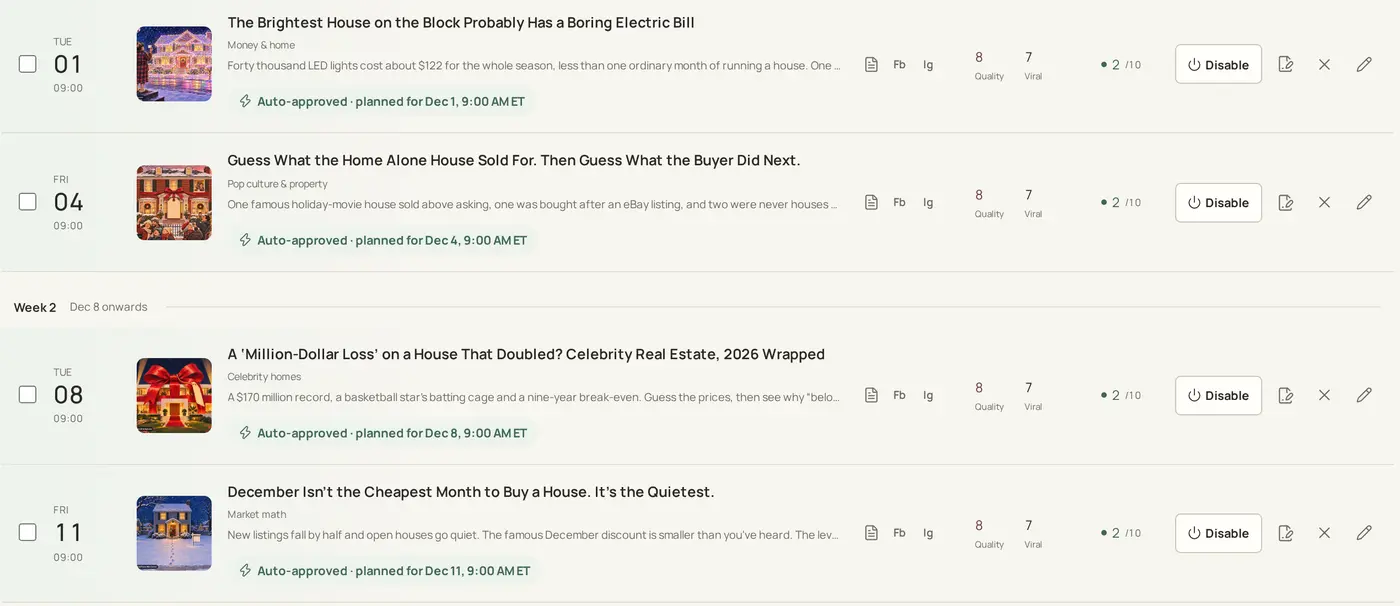
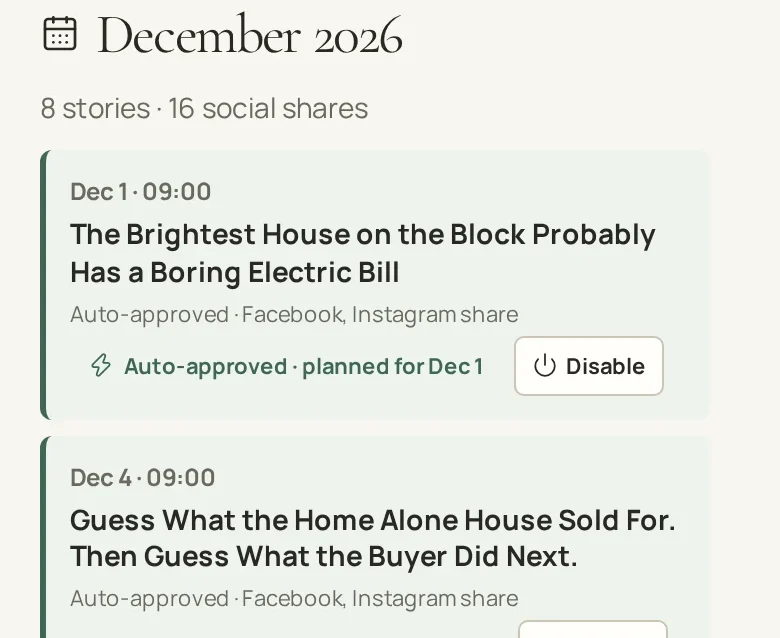
Until now, Wire stories landed in your WordPress drafts and waited for you. Some members never opened them; a few sites hold hundreds of unread drafts. Others published stories they hadn't really looked at, and didn't want. In 2027, the whole month lives in one place: Wire, at wire.virtualresults.com. These are real Wire screens, loaded with the December edition.

- Your choice of approval. Approve each story yourself, or have them approved automatically. A story goes to your website on its planned date, never earlier, and a story our quality check flags waits for your approval.
- Your social accounts. Facebook, Instagram and Google Business Profile each show their own status at the top, so you can see at a glance whether shares will go out.
- The calendar. Each story sits on its date with its time and its two social shares. Next to each one is Disable.
- Disable. One click and that story never publishes. Change your mind and turn it back on.
| Before | 2027 |
|---|---|
| Stories dropped into your drafts folder | The whole month in one place, in Wire, as a calendar (a list on your phone) |
| Nothing told you what was coming | Every story shows its date and status |
| Publishing meant digging through drafts | Your choice per site: approve each story, or have them approved automatically with a one-click Disable on any of them |
| Stories could go live before anyone looked | Nothing publishes before its date, and flagged or edited stories wait for a person |
| Social was a separate job | Shares to Facebook, Instagram and Google Business Profile, with each account's connection shown at the top. A verified "Posted" mark for every share is on its way. |
| A generic link back to us | Calls to action into your own pages |
The month view, the per-site settings, the ratings and Disable are built. Automatic publishing and a verified "Posted" mark for every share are being switched on for 2027.
What we have planned for 2027
We've mapped the year day by day: 182 dated events from January 2027 into January 2028, from Fed meetings and tax deadlines to the Super Bowl on Valentine's Day and Hanukkah starting on Christmas Eve. From that calendar we planned 104 stories, two a week, each in one of six formats. Here is one from every month:
Market stats Cerebral Funny Celebrity Calculator Quiz
- Market stats 2026 in Five Numbers: What the Year's Home Sales Really Said Why then: NAR existing-home sales, Dec 2026 data (Jan 14) Sales, median price, inventory, days on market and first-time buyer share, each with one plain sentence.
- Funny The Super Bowl Falls on Valentine's Day. America's Living Rooms Must Choose Why then: Super Bowl LXI + Valentine's Day (both Feb 14) First time ever: a playful look at couch diplomacy, candlelit wings and how households will split the room.
- Funny The Home Feature Bracket: 64 Must-Haves Enter, One Survives Why then: Selection Sunday (Mar 14) / March Madness Mudroom vs. walk-in pantry, primary suite vs. home office: a seeded bracket using buyer-survey data.
- Quiz Tax Day Quiz: Which Homeowner Deductions Are Real? Why then: Tax Day (Apr 15) Mortgage interest, the property-tax cap, home office, and which energy credits ended after 2025: test your knowledge before you file.
- Cerebral Hurricane Season Starts June 1. The Two-Hour Prep That Matters Most Why then: Hurricane season starts (Jun 1) Ranked by impact: documents, photos of belongings, shutters, generator safety, the insurance check.
- Calculator Watch-Party Math: How Many Fans Can Your Living Room Really Hold? Why then: Women's World Cup kickoff (Jun 24) Square footage, seating and sightlines in, a realistic guest count out.
- Market stats One Year to the LA Olympics: What Host Cities' Home Prices Did Why then: LA28: one year to Opening Ceremony (Jul 14) Atlanta, London, Paris: the research on Olympic housing booms and busts.
- Funny How a Town of 7,000 Rents Out Its Lawns During the Sturgis Rally Why then: Sturgis Rally (Aug 6-15) The yard-campsite economy of Sturgis, South Dakota, for ten loud days.
- Quiz Quiz: Do You Speak Mortgage? Why then: FOMC (Sep 14-15) / Q3 estimated tax APR vs. rate, escrow, points, PMI: ten terms, plainly explained.
- Funny Are 'Haunted' Houses Harder to Sell? Why then: Halloween run-up Stigmatized-property disclosure laws by state, and the buyers who pay extra for a ghost story.
- Funny Fourteen Guests, Table for Six: The Funny Math of Thanksgiving Hosting Why then: Thanksgiving prep Card-table extensions, the ottoman as seating and square-footage-per-guest humor.
- Cerebral Hanukkah Starts on Christmas Eve This Year. How Shared Homes Celebrate Both Why then: Hanukkah begins on Christmas Eve (Dec 24) Interfaith households on menorahs beside trees, and how the calendar lines up.
All 104 are on the 2027 slate. Every story is a working headline until it's written, and the facts get to change it: in December, the data overturned the premise of more than one story.
The fine print, honestly
The AI writer behind the Home Alone story cost about $5 at Anthropic's published API prices, because 13.6 million of its 13.8 million tokens were cheap rereads of its own notes. The tokens are the cheap part. The value is in what happens around them: a second AI model told to disagree, a writer sent back to the source, art made for one story only, a person at Virtual Results who reads every proof, a page checked on a phone, and a calendar that publishes into your site on your schedule with your links.
Shared copies don't help you rank in Google; that's what your own rewrites and stories written for you are for. We can't yet show you that a Wire story brings you leads: that needs a year of 2027 analytics we don't have. And if you want volume, video scripts and an email builder, Keeping Current Matters is broader, and it's good at that:
| Keeping Current Matters | AgentFire Plus | Real Estate Wire Service | |
|---|---|---|---|
| Price | $59.95 a month, or $99.95 for Elite (less billed yearly) | $50 a month (an AgentFire upgrade) | No charge to Virtual Results clients |
| Stories | 4 articles and 1 infographic a week | 3 AI-written articles a month | 104 illustrated, sourced, independently reviewed stories a year (two a week) |
| Same for every member? | Some content is the same for all members | Not stated | Yes, shared stories are the same; your calls to action differ |
| Interactive | Not stated | Not stated | Calculators, quizzes, reveals |
| Social | Auto-posting to Facebook, Instagram and LinkedIn | Not stated | Facebook, Instagram and Google Business Profile |
| Extras | Video scripts, email builder, guides, local data (Elite) | 3 hours of human help a month; AI email drip campaigns | Your own calls to action; approve or Disable each story |
Read one before you trust us
Every Wire story ends with its sources, and every number in it links to one. Every story's review is kept on file: what the reviewers said, what we changed and what we didn't. If a story doesn't fit your market, Disable it. If you find a mistake, tell us and we'll fix it for every member at once.
Here's a test that takes five minutes. Open any story in the portfolio, pick three numbers, and click through to their sources. If the source doesn't say what we say, we've failed, and we want to hear about it.
Sources
- Production counts: Virtual Results Wire December 2026 package logs (writer token logs, Jasper receipts, Codex logs, review records), read November 23, 2026.
- Keeping Current Matters, pricing, personalized posts and FAQ, read November 23, 2026.
- AgentFire, Introducing AgentFire Plus, read November 23, 2026.
- Verblio, pricing, read November 23, 2026.
- Editorial Freelancers Association, editorial rates (survey of 2025 rates), read November 23, 2026.
- Creative Boom, freelance illustration rates (magazine spot $250–400), January 17, 2022.
- Buffer, pricing (Essentials $5 per channel a month); Hootsuite, plans, read November 23, 2026.
- Jasper, pricing; Claude, plans; ChatGPT, Pro plans, read November 23, 2026.
- Anthropic, API pricing (Claude Opus 5.5: $4 per million input tokens, $20 per million output, $0.20 per million cached reads), read November 23, 2026.
- Virtual Results, introducing the Real Estate Wire Service, October 21, 2026.
- Wire screens: wire.virtualresults.com, captured November 23, 2026.
- 2027 calendar and slate: Virtual Results Wire planning calendar, built November 23, 2026 from OPM, Federal Reserve, Hebcal, timeanddate.com and league schedules. See the 2027 slate.