
The car has somewhere to sleep. The person is still looking.
That is the absurd little scene inside a parking minimum: a rule that can require a new home to arrive with off-street accommodation for a vehicle, whether or not the future occupant plans to own one. In a crowded city, the car gets an unusually attentive housing advocate. It is the zoning code.
New York began unwinding that arrangement with City of Yes for Housing Opportunity, adopted on December 5, 2024. Its most interesting idea is still worth arguing about: parking demand and a government parking mandate are different things.
Why Are You Buying a Parking Space You Don’t Want?
A builder who expects residents to pay for parking may have a reason to provide it. A mandate makes that decision in advance. It can bind the home to another product before either buyer has turned up.
Think of an apartment search in which every listing came with a mandatory grand piano. Some people would love the piano. Others would ask why the room, the building and the bill had been arranged around an instrument they cannot play. Parking is more useful than a grand piano to many households. The question is whether every household needs the bundle.

There is no honest universal conversion from a removed parking space to a new apartment. Building design, circulation, financing and other rules still matter. Losing a requirement does not produce an extra home by magic, and a developer can keep the parking anyway. What changes is the decision that must be made before the project can proceed.
Did New York Actually Get Rid of Parking Requirements?
The Department of City Planning’s adopted-plan overview describes three different treatments. New residential parking requirements are absent in the Manhattan Core and Long Island City parking areas and the Inner Transit Zone; they are reduced in the Outer Transit Zone; and most remain outside those areas, with exceptions. The Council’s modification summary, pages 4–5, explains the compromise and its response to differing transportation needs.
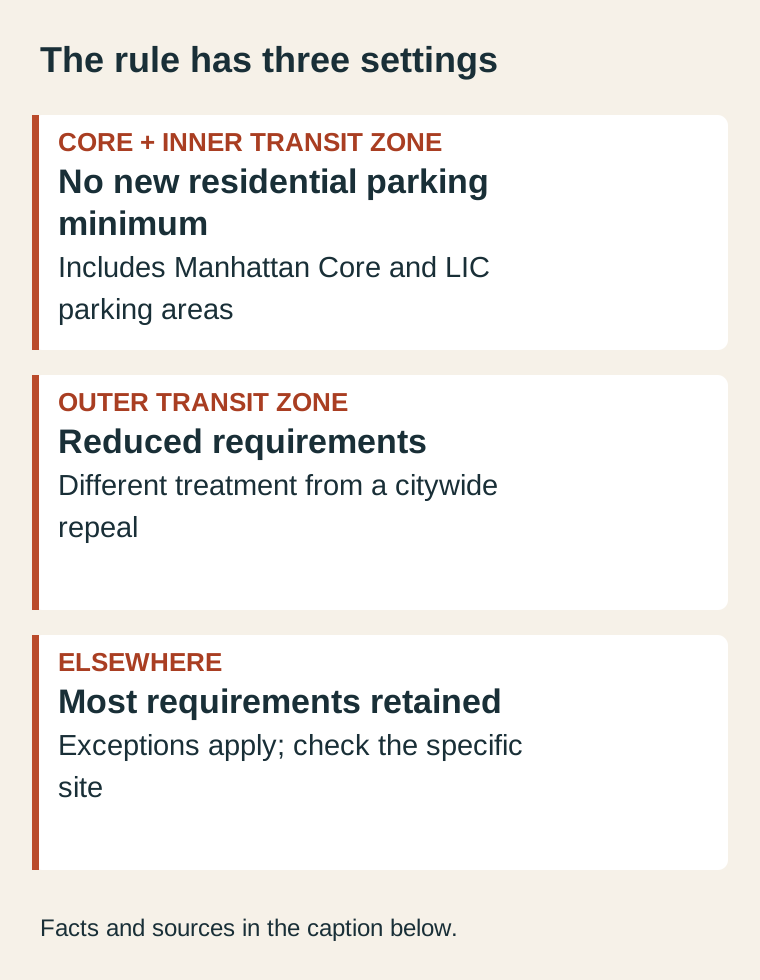
The geography is the argument. A household beside useful transit has different options from a household whose work schedule, disability, caregiving or destination makes a car necessary. The Council’s changes acknowledged that difference rather than treating every block as the same transportation market.
Where Does Everyone Else Park?
A neighbor can reasonably worry that residents of a building without a garage will still own cars. If they use an already crowded curb, the neighborhood gets the spillover while the builder saves the space. A person arriving home from a late shift is unlikely to be delighted by a lecture about efficient land use.
That objection deserves an answer about the curb, accessible transportation and local conditions. It does not establish that every new apartment needs a parking space. Requiring a private garage is one way of trying to manage the consequences of a car-dependent place; it is also a condition attached to creating a home. Those are two responsibilities worth discussing separately.
Nor should anyone sell this reform as a guaranteed rent cut. The Council’s estimate of housing enabled by the entire City of Yes package is a projection across many changes, not a count of apartments delivered by parking reform. Permission, construction and affordability are separate hurdles.
Before You Demand Another Parking Space, Ask This
When someone says a project needs more parking, ask what problem the extra spaces would solve, who would use them, and what the requirement would change about the housing. When someone says parking is irrelevant, ask how the people who actually need cars are supposed to manage.
The useful argument is about making room for both realities. A city can let builders provide parking without insisting that a vehicle’s accommodation is always the admission ticket for a person’s home.
The car may still get a bedroom. It should at least have to explain why.
Sources and context
- New York City Council: adoption announcement, December 5, 2024.
- NYC Planning: City of Yes adopted-plan overview, adoption dated December 5, 2024; accessed October 20, 2026.
- Council modifications summary, November 2024, especially pages 4–5. Check current zoning for any individual site.