New listings fall by half. Open houses go quiet. The famous December bargain is smaller than you've heard. The real edge is simpler: fewer buyers in the room.
Every December, much of the country seems to stop shopping for houses. The listing sites get fewer clicks, the open houses get fewer cars, and the people who do show up have snow on their boots.
The popular version says December is when homes go on sale. The data says something less tidy and more useful. December is not the cheapest month to buy a house. It is one of the quietest, and a quiet room is a better place to negotiate than a crowded one.
December gets thin fast
Start with how deep the December lull really goes. In the U.S. data Realtor.com publishes every month, sellers put 235,040 new listings on the market in December 2025. In April 2026 they listed 477,118. December brought out about half as many homes as spring. No other month in the past year came close to that low. Spring listing photos have tulips. December listing photos have one wreath and an empty driveway.
The homes that were for sale sat longer. The typical December listing had been on the market 73 days, compared with 52 days in April and May. Fewer deals were getting done, too. Realtor.com counted about 347,000 listings under contract in December, down from about 508,000 in May. January was slower still, at 78 days, so the quiet season runs straight through New Year's.
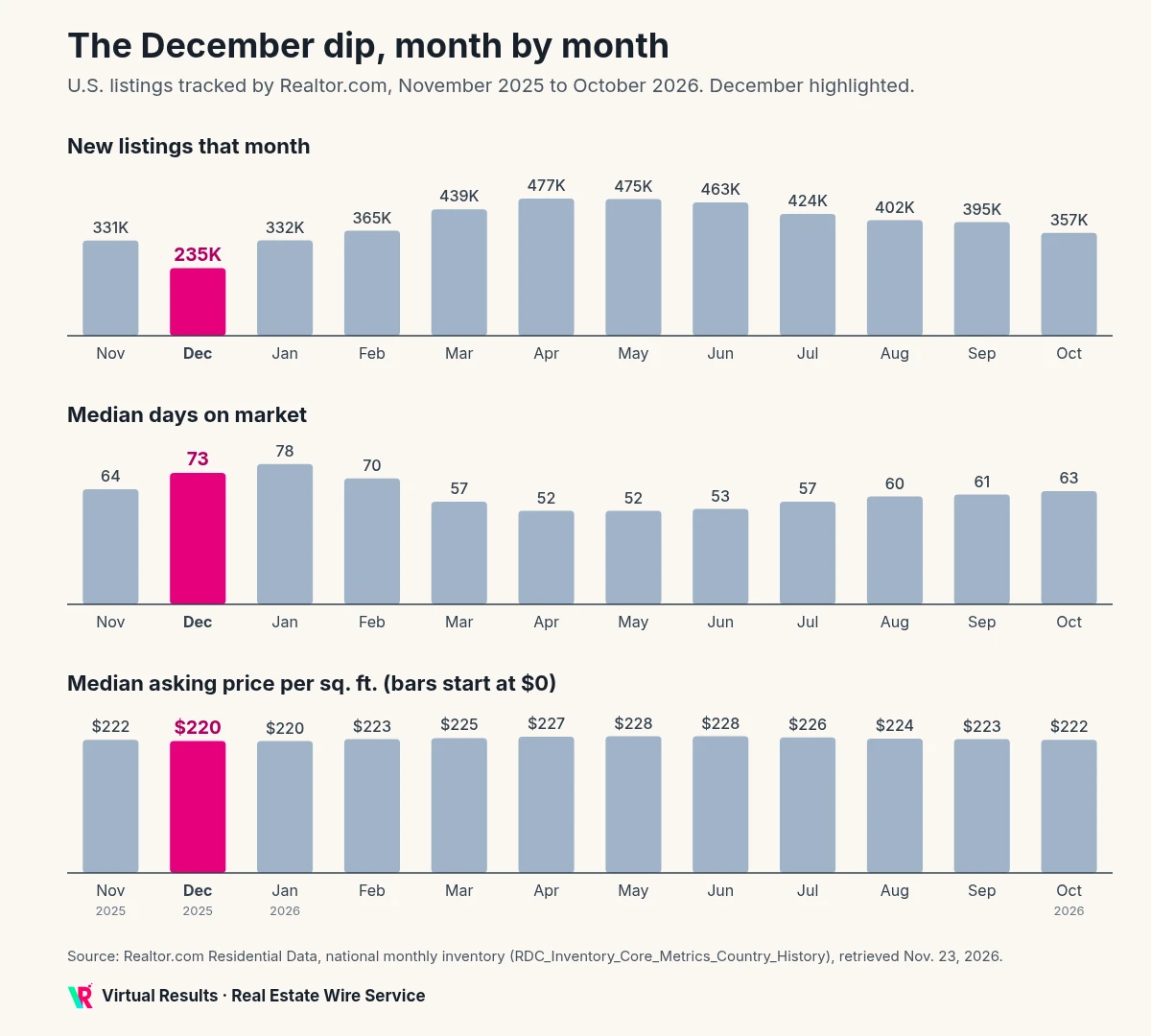
Now look at the bottom row. Asking prices per square foot, a rough way to adjust for home size, slipped from $228 in May and June 2026 to $220 in December 2025. That is a 3.5% difference. A year earlier the same December-to-May gap was about 5% ($222 to $234). It is real, but nobody would call it a clearance sale.
The December discount is smaller than the legend
ATTOM, a property-data company, compares what homes actually sold for with its estimate of their market value on the day of sale. Its November 2026 analysis covers more than 48 million sales from 2016 through 2025. In that decade, buyers paid more than the estimate in every month. The best month nationally was July, at 6.3% over. December tied September at 8.2%.
December isn't the cheapest month. Its best day is the cheapest day.
How far above estimated market value buyers paid, U.S. home sales 2016–2025. Lower is better for buyers. These are the months and days ATTOM's report singles out; it does not publish every month.
Source: ATTOM 2026 Best Days to Buy a Home analysis, Nov. 12, 2026. Premium = median sale price over median automated valuation for homes closing that day or month.
Here's the strange part. The month as a whole is ordinary, but its quietest corner is the best spot on the calendar. Homes that closed on December 24 sold for just 3.2% above ATTOM's estimate, the lowest premium of any day in the year. Homes that closed on May 27 went for 14.5% over. One caution: a closing date reflects a deal struck weeks earlier. The Christmas Eve number says more about which deals close then than about haggling on the day.
Realtor.com points elsewhere too. Its 2026 Best Time to Buy report named September 27 to October 3 as the best week nationally, with 13.3% more listings than an average week and listing prices about 3.5% below the peak. That is a fall sweet spot, when choice is still wide and competition is fading.
So the myth is half right. December is not where the deepest price cuts live. It is where a lot of the competition goes missing.

The real advantage is the empty room
Bidding wars need bidders. In December 2025, according to Redfin, the typical home sold for 1.8% below its final list price, and only 22% of homes sold above it. That was the lowest December share since 2019. Redfin's report that month said, "Buyers hold the negotiating power in most markets today." The 1.8% is an average, not a coupon. But it describes a month when paying over asking was the exception.
That leverage doesn't always look like a lower price. It can look like time to get an inspection without six other offers pushing you to waive it. It can look like the seller paying some closing costs, or agreeing to a closing date that suits you.
There's also a pattern worth reading, though it isn't proof of anyone's motives. Only 12.9% of active listings had a price cut in December 2025, the lowest share of the year. Fall is when sellers trim. One likely reading: by December, many homes that needed a cut have had one or left the market. The data can't tell you why any one seller is still listed over the holidays. Your agent can ask. Either way, a cut probably won't come to you. Ask for one.
Why some buyers should stay on the couch
Fewer rivals also means fewer choices, and the choices were already thin. At the end of December 2025, the National Association of Realtors counted 1.18 million existing homes for sale, down 18.1% from November. That was a 3.3-month supply, down from 4.2 months a month earlier. If the right house isn't listed in December, being the only buyer doesn't help.
The calendar works against you too. Holiday weeks can slow inspectors, appraisers, lenders and title offices. The Consumer Financial Protection Bureau notes that rate locks typically run 30, 45 or 60 days and warns that extending one "may be expensive." A contract signed in mid-December with a 30-day lock leaves little room for New Year's delays.
Mortgage rates are the bigger wild card. They don't follow the seasons, which is why Realtor.com leaves them out of its best-week math. A small seasonal price dip can vanish if rates rise in the same month.
Local markets also run on their own clocks. Realtor.com put the best week for Miami and Tampa at November 29 to December 5, which is right in the holiday season. Its best week for Phoenix and Tucson was November 1 to 7. ATTOM found buyers in Minnesota did best in December, paying right at estimated value, while Michigan buyers did best in November, at a 1.7% discount. Even in December 2025, Redfin found 54.2% of Newark-area homes selling above list price, compared with 5.3% around West Palm Beach. A quiet December in Florida and a quiet December in New Jersey are not the same month.
A December buyer's checklist
- Get preapproved before the holidays start. When a good house appears in a thin month, you want to be the buyer who is ready to write an offer.
- Ask your agent how long it's been listed. A home that has been listed since summer may have a seller ready to talk terms.
- Negotiate the terms, not just the price. Repairs, closing costs and the closing date are all on the table when you're the only offer.
- Match your rate lock to a holiday calendar. Ask your lender what an extension costs, and consider a longer lock if closing crosses late December.
- Book the inspector and appraiser the day you go under contract. Confirm everyone's holiday schedule, including the lender's.
- Use the season as an inspection. Where winters are cold, check the heating, drafts, ice along the roof edge and how the driveway handles snow. It's a stress test spring buyers don't get to watch.
- Don't buy just because it's December. The empty room is useful leverage. It isn't a reason to choose the wrong house.
If the usual pattern holds, spring will bring about twice the new listings and a lot more company. Until then, the open house is quiet and the cocoa is hot. That's no guarantee of a bargain. It's a chance to be the one buyer the seller is actually talking to.
Sources
- Realtor.com Residential Data, national monthly inventory history (new listings, days on market, price per square foot, pending listings, price-reduced share), November 2025–October 2026, retrieved Nov. 23, 2026.
- ATTOM, 2026 Best Days to Buy a Home analysis, Nov. 12, 2026.
- Realtor.com, 2026 Best Time to Buy report, September 2026.
- Redfin, December 2025 housing market report, Jan. 15, 2026.
- National Association of Realtors, December 2025 existing-home sales (release as published by Florida Realtors), Jan. 14, 2026. NAR existing-home sales data.
- Consumer Financial Protection Bureau, "What's a lock-in or a rate lock?"