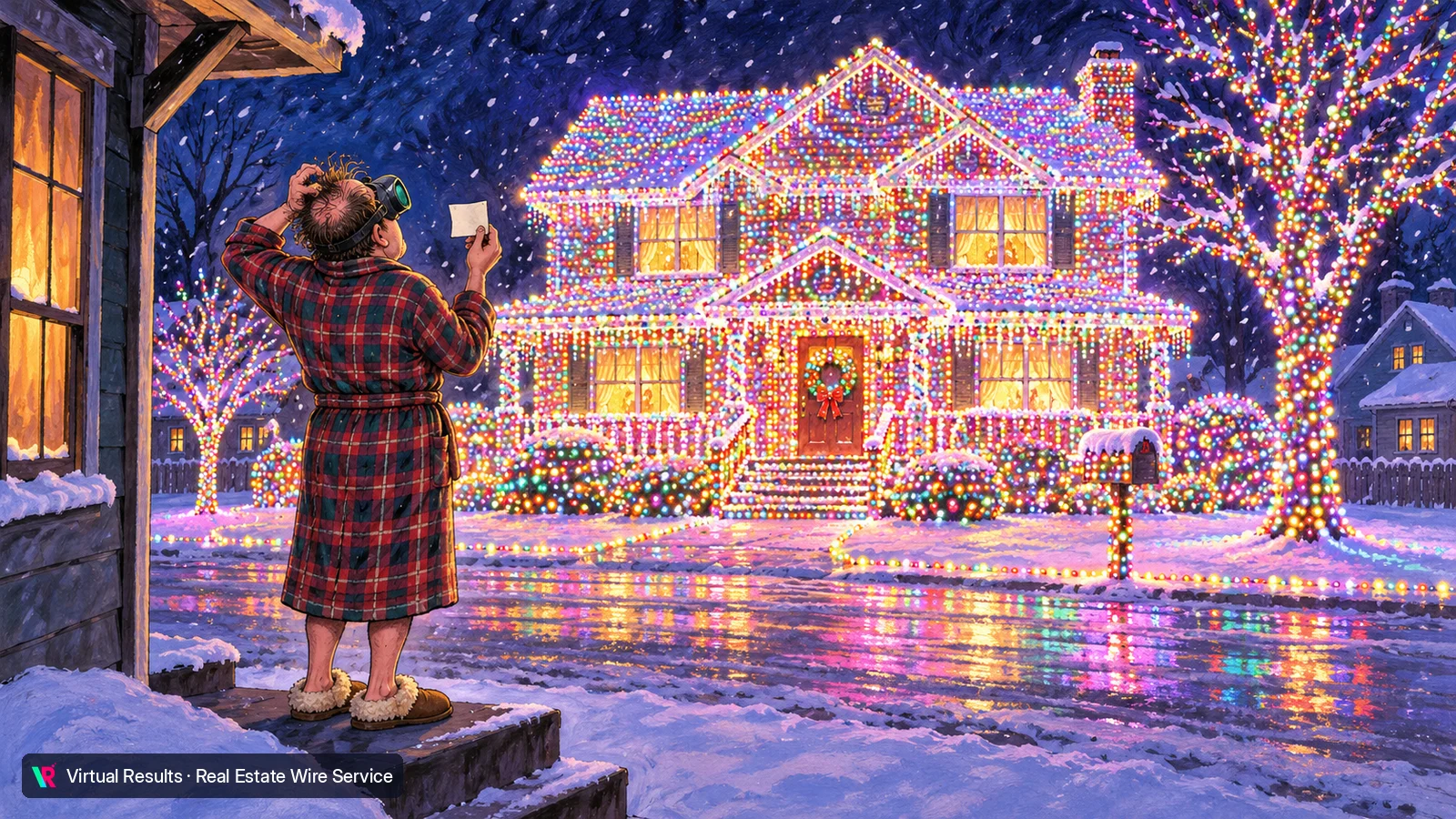
Every street has one: the house that goes up the weekend after Thanksgiving and stays lit until the neighbors could read a paperback in their own driveway at midnight. Roofline, gutters, shrubs, mailbox, the dog's crate. Somebody across the street always says it: "Imagine that electric bill."
So we ran it. The answer comes down to one detail you usually can't spot from the sidewalk. It isn't the number of lights. It's the bulb.
Guess first: what does a 40,000-light LED display cost to run for the whole season?
About $122. That's 40,000 LED mini lights, six hours a night, for 40 nights, at the August 2026 national average residential price of 18.16 cents per kilowatt-hour. An average American home's monthly electricity use (899 kilowatt-hours, per the EIA's 2022 figure) would cost about $163 at that price. So an entire blinding season costs less than one ordinary month of running a house. Swap in old incandescent minis and the same display costs about $715. Swap in fat incandescent C7 bulbs and it jumps to $10,460, on paper. In real life, the house couldn't even power it.
The math that kills the gossip
Electricity costs come down to four numbers: how many watts, how many hours, how many nights, and what your utility charges per kilowatt-hour. Multiply the first three, divide by 1,000 and you have kilowatt-hours. Multiply by the price and you have dollars.
Here's the comparison that matters. A 70-light set of 5mm LED minis sold by Christmas Lights Etc. is rated at 4.8 watts, or about 0.07 watts per bulb. A 100-light set of Wintergreen Lighting incandescent minis is rated at 41 watts, about 0.41 watts per bulb. Cornell Cooperative Extension's holiday-lights fact sheet puts an LED C7 at 0.08 watts and a standard incandescent C7, the big bulbs that come to mind when you think of a 1970s roofline, at 6 watts.
One old incandescent C7 draws about as much power as 85 LED minis. A roofline of LED C7s and a roofline of incandescent C7s can look almost the same from the street, and the incandescent one costs about 75 times as much to run.
For a price, we used the EIA's most recent monthly figure: 18.16 cents per kilowatt-hour, the national average residential price for August 2026 (preliminary, published October 23, 2026). Your own rate could be well above or below that. That's why the calculator lets you change it.
The arms race your electric meter slept through
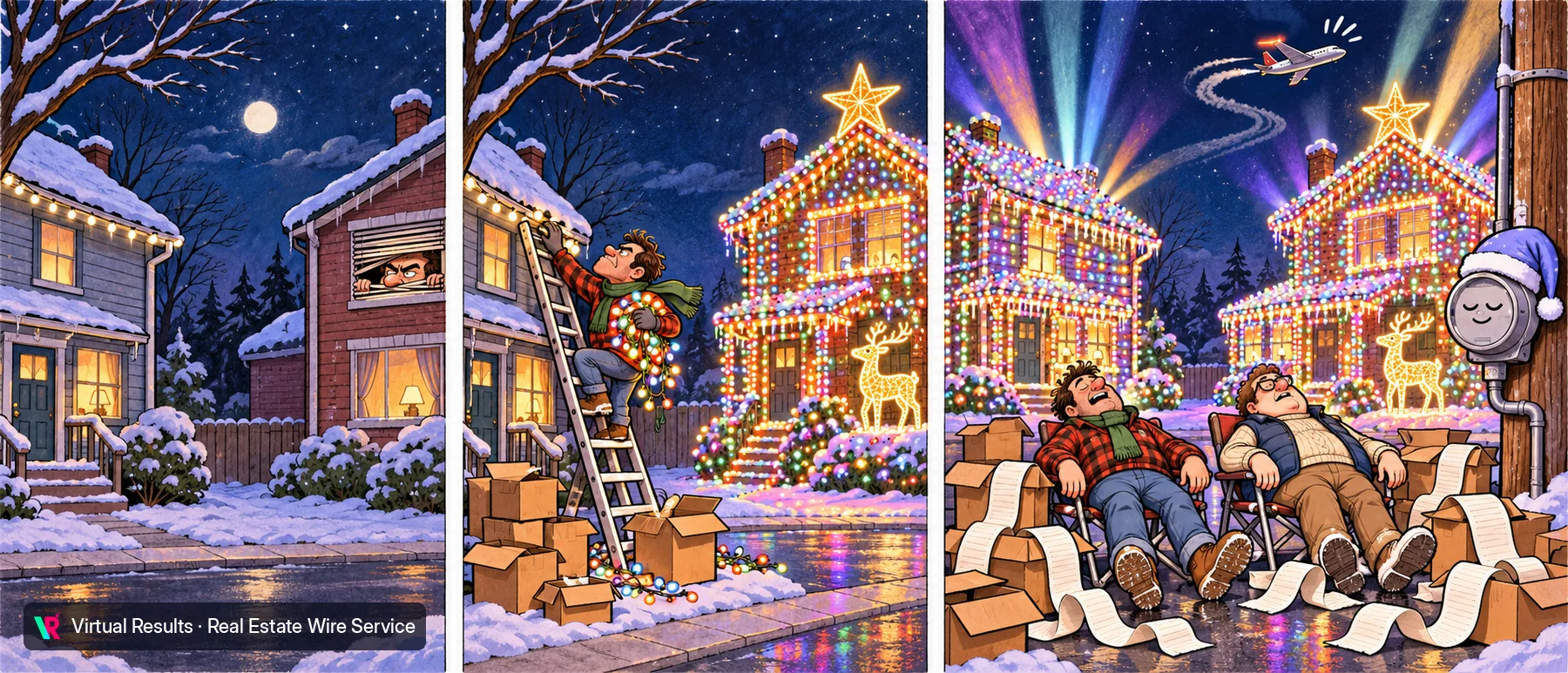
Here's the part of the neighborhood light war almost nobody prices out. With LEDs, adding another 10,000 bulbs to the same six-hours-a-night schedule adds roughly $30 to the season at the national average price. The ladder, the clips, the timer and the extra strings cost more than that before a single one is plugged in.
The world-record house says its bill is about $350
The Gay family of LaGrangeville, New York, holds the Guinness World Record for most lights on a residential property. Their own light-count history lists 760,754 lights for 2026, run through more than 3,000 extension cords and synchronized to music. The family FAQ answers the electric-bill question directly: "Not very much. About $350/year, now that the display is almost completely LED's." The electricity, it adds, "is a minor part of the total cost, which only I and I alone, know."
Here's the strange part. If all 760,754 LEDs burned at once at 0.07 watts each, they would draw about 53 kilowatts, and $350 at the national price buys only about 1,900 kilowatt-hours, which is roughly 36 hours at full blast. One possible explanation is the show itself: a music-synced display flashes, chases and dims its lights in sequences rather than holding every bulb at full power. We can't confirm that. The $350 figure is self-reported and undated on the FAQ, and CBS New York reported the same number back in 2019, when the display had 641,695 lights. Even so, it points the same way as every other figure here: once the bulbs are LEDs, the electricity stops being the expensive part.
The record book also shows the old way. The family's light-count history notes that the 601,736-light display that reclaimed the Guinness title in 2014 included incandescent lights run on a generator.
One season of lights versus one month of your house
Energy cost at 18.16 cents per kWh. Light displays run six hours a night for 40 nights. The inflatable runs around the clock. The two smallest bars are drawn at a minimum width so you can see them.
Source: wattages from manufacturer listings (Christmas Lights Etc., Wintergreen Lighting) and the rating of a Gemmy Airblown power supply; price from EIA Electric Power Monthly, Table 5.3 (August 2026, preliminary); home use of 899 kWh a month from the EIA (2022 average).
The bulb that breaks the bill, and the house
Run 40,000 incandescent C7s through the calculator and you get about $10,460 for the season. You're unlikely to see that on a real bill, because an ordinary house can't power it. Forty thousand 6-watt bulbs would need 240 kilowatts, about 2,000 amps at 120 volts. A typical 200-amp home electrical service tops out around 48 kilowatts on paper. You'd need roughly five houses' worth of service, or a generator, before the first carol.
That's the real tell from the sidewalk. Fat, warm, glass C7 and C9 bulbs strung in the thousands usually mean either LED replacements that only look old-fashioned, or a homeowner who has made very good friends with an electrician.
Wait, what about the giant inflatable Santa?
The yard inflatable is everybody's favorite suspect, and the small ones are mostly innocent. One Gemmy Airblown manual rates its power supply's output at 12 volts and 1,000 milliamps, which works out to 12 watts. A newer Gemmy supply is rated at 12 volts and 2.3 amps. Those are ratings, not meter readings, and the draw at the wall runs a little higher. Gemmy's own FAQ says an Airblown inflatable "uses about as much energy as a standard string of holiday lights." If a small one drew 12 watts day and night for 40 days, it would cost about $2. Big animated models and commercial-style blowers draw far more. Santa's waistline tells you nothing about his wattage, so read the label.
The case against the brightest house on the block
The electricity was never the expensive part. Switching cuts the power bill, but slowly. Replacing one 100-light incandescent mini string with an LED one saves about $1.48 a season on our six-hours-a-night schedule. If the new string costs more than a few seasons' savings, the payback has to come from somewhere else. LEDs run cooler and their bulbs are harder to break. That's a fine reason to switch. "It'll pay for itself in a month" isn't.
Your neighbors pay in sleep, not dollars. The National Park Service, which manages dark-sky parks, recommends outdoor light "only when needed," on motion sensors or timers, in warm-white or amber tones rather than blue-white. A cheap display can still light up someone's bedroom until 2 a.m.
Your HOA may have opinions. When an Idaho couple, Jeremy and Kristy Morris, planned a Christmas show in their new subdivision, the homeowners association's attorney warned it would break rules against "nuisances, excessive lighting," and animals other than "ordinary household pets." According to a federal appeals court, the show featured "an estimated 200,000 lights" and a camel named Dolly. A jury sided with the Morrises; the judge set the verdict aside, and the fight ran through the Ninth Circuit until the U.S. Supreme Court declined the case in January 2025. Read your covenants before you buy the 50,000-light kit.
Before you escalate
If you're the neighbor, you can probably stop worrying about their bill. If you're the one with the lights, here's the cheap way to win.
- Read the label. The watts printed on the box or tag decide your bill. Divide by the number of bulbs and run it through the calculator.
- Buy a timer. Going from 12 hours a night to six cuts the bill in half and keeps the bedroom across the street dark after the show is over.
- Retire the vintage incandescents first. They cost the most to run and run the hottest. The newest LED strings can wait.
- Respect the circuit. Follow each string's "max sets connected" rating. If your plan is measured in amps rather than strings, call a licensed electrician before you call the neighbors out.
Then enjoy the glow. With LEDs, the electricity is the easy part of being the brightest house on the street. Getting 40,000 lights back into their original boxes in January remains unsolved.
Sources
- U.S. Energy Information Administration, Electric Power Monthly Table 5.3: average residential price, 18.16 cents/kWh for August 2026 (preliminary; released October 23, 2026).
- EIA: How much electricity does an American home use? 899 kWh per month in 2022.
- Cornell Cooperative Extension, Holiday Lights Fact Sheet (2013): 0.08 W LED C7, 0.48 W incandescent mini, 6.0 W incandescent C7.
- Christmas Lights Etc. 70-light 5mm LED set: 4.8 W, 0.0686 W per bulb. Wintergreen 100-light incandescent mini set (via Bulb America): 41 W.
- Oak Ridge National Laboratory (2002): 41 watts per 100-light incandescent mini string.
- ENERGY STAR: decorative light strings: certified LED strings use about 70% less energy than incandescent strings.
- Gemmy Airblown inflatable manual (12.0 V, 1,000 mA power supply; energy FAQ) and a newer Gemmy manual (12 V, 2.3 A).
- ERDAJT (Gay family) holiday display FAQ: light-count history, about $350 a year for electricity, extension cords. CBS New York (2019) reported the same $350 figure.
- News 12 video, December 2021.
- National Park Service: Night Skies at Home.
- Morris v. West Hayden Estates First Addition HOA, Ninth Circuit opinion (June 17, 2024) and Supreme Court docket 24-558 (petition denied January 21, 2025).
All costs are estimates computed from the cited ratings and the national average price, not measurements of any particular home. The illustrations are ours.